
Harrison County Parole Versus Probation
Parole and probation can both place a released person under rules in the community, but they arise at different points. The Texas Board of Pardons and Paroles decides parole and mandatory-supervision release. The TDCJ Parole Division then supervises those released from a state prison. Harrison County probation is ordered by a court and administered through the local Community Supervision and Corrections Department, or CSCD. Someone may receive probation without ever entering TDCJ custody.
A parole record therefore does not prove present residence in Harrison County. It shows that state authority continues over the unexpired sentence. A probation judgment shows the court imposed community supervision, but the public docket may not reveal every condition or current reporting detail. Start with the source that created the supervision.
| Point | Parole or mandatory supervision | Probation or community supervision |
|---|---|---|
| Source | State prison release decision | Sentencing court order |
| Decision maker | Texas Board of Pardons and Paroles | District or county court |
| Supervising office | TDCJ Parole Division | Harrison County CSCD |
| Best public trail | TDCJ record and parole review information | Judgment, docket, discharge or revocation order |
| End point | Discharge from state supervision | Court or CSCD discharge |
Verify Harrison County Post-Release Supervision
Identity comes first. Similar names can lead to the wrong case. Use a TDCJ number, date of birth, conviction county, or case number when available. A person who only left the Harrison County Main Jail on bond is not automatically on parole or probation. The jail release transaction shows the exit, while the judgment and supervision record explain any later duty to report.
- Decide whether the person left Harrison County jail, TDCJ prison, or both.
- For a state prisoner, open the TDCJ Inmate Search and compare identity and conviction details.
- Read the Parole Review Information and any release or supervision status shown.
- Confirm the assigned district through the official Parole Division directory.
- For probation, locate the sentencing court judgment and later docket orders.
- Ask Harrison County CSCD about its reporting office and process within lawful disclosure limits.
- Request a TDCJ or court record when the public result is incomplete.
A live jail roster answers current custody, not whether a released person is now on parole or probation.
The broader Harrison County released inmate search can help distinguish a jail departure from a transfer before supervision is checked.
Marshall Parole Office Records
TDCJ assigns Harrison, Marion, Panola, and Shelby counties to the Marshall District Parole Office in Region I. This local assignment is the key Harrison County route for state parole and mandatory-supervision reporting. It is not a county probation office, and it does not answer ordinary jail-release questions for someone who has no TDCJ supervision.
2304 East Travis Street
Marshall, TX 75670
Phone: (903) 938-1277
Fax: (903) 938-6164
The official Marshall office listing should be checked before a visit because assignments and contact details can change. The office may address reporting and supervising-office issues within lawful limits. Historical release certificates or discharge records instead belong with TDCJ records channels.
The official parole district directory by county shows how Harrison County is routed. The directory image below captures that state source, and the county assignment should still be verified on the live page.
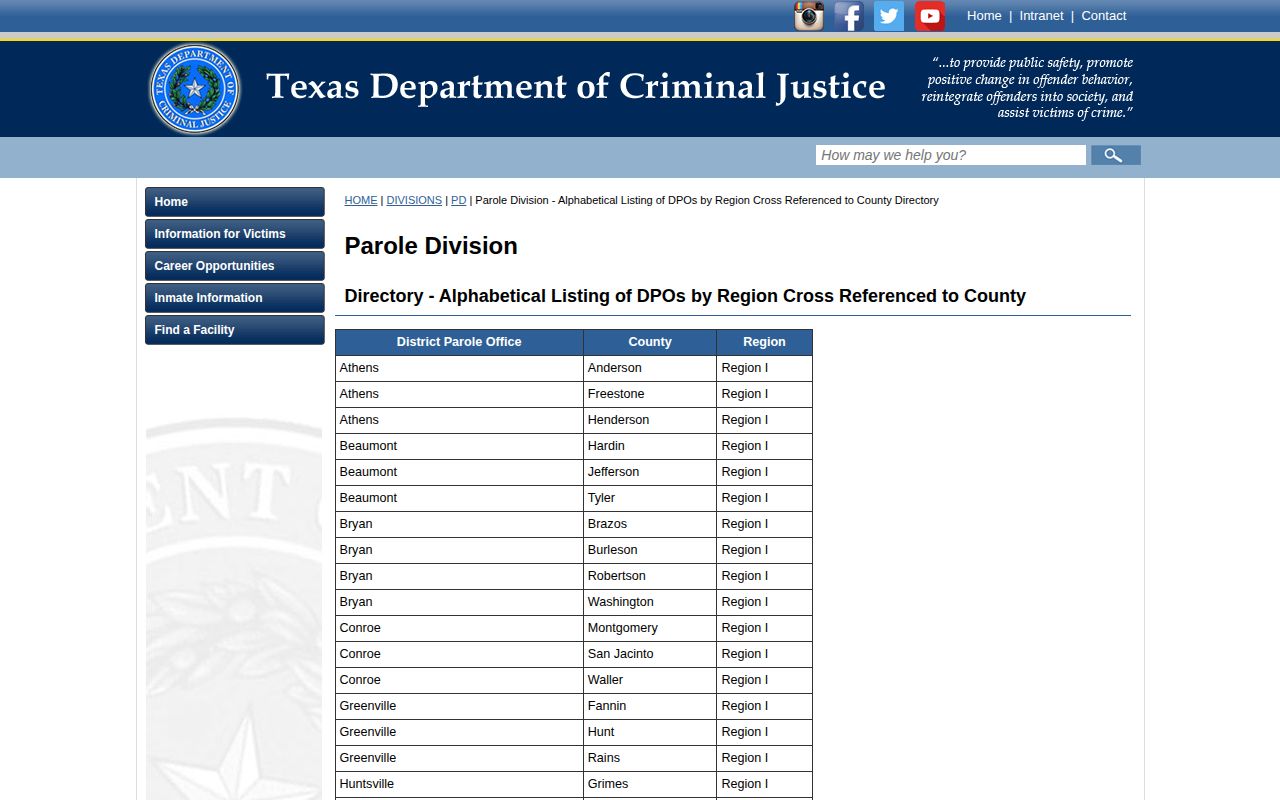
This directory separates the state supervision channel from the Harrison County probation channel.
Harrison County Probation Verification
There is no supported public Harrison County probationer locator comparable to the TDCJ offender search. Begin with the sentencing court. The District Clerk handles adult felony records, while the County Clerk handles Class A and B misdemeanor matters and County Court at Law records. Search for the judgment, community-supervision term, modification, revocation, and discharge order. A prior jail release time and a later probation event are distinct facts.
Harrison County Courthouse
200 West Houston Street, Room 336
Marshall, TX 75670-4028
Phone: (903) 923-4016
Fax: (903) 927-2236
CSCD is part of the local judicial-district supervision system. Its staff are not TDCJ parole employees. Public court records may show the term and outcome, while some supervision details remain restricted. A discharge order means supervision ended under the order; it does not erase the arrest or prove when an earlier jail exit occurred.
Harrison County Warrants and Absconders
An absconder is a person alleged to have stopped reporting or whose whereabouts are unknown to the supervising authority. A warrant can follow an alleged parole or probation violation. That status means the supervision issue remains unresolved and the person may be arrested. It is not a second release event, and it should not be inferred from a missed appointment or a stale web page.
For state parole, use TDCJ and the supervising office. For probation, review the sentencing court docket for a motion to revoke, warrant entry, bond action, hearing, or final order, then confirm through the court or CSCD. Do not confront the person. Public records can lag, and a warrant may have been withdrawn or resolved after the last visible event.
- Parole
- Conditional release from state prison while TDCJ authority continues.
- Mandatory supervision
- A state release form governed by eligibility and Board review rules.
- Probation
- Court-ordered community supervision, which may occur without a prison term.
- Absconder
- A supervision status tied to loss of contact or failure to report.
- Discharge
- The formal end of the applicable supervision term.
Harrison County Parole Decisions
Parole eligibility is not a promise of release. Texas Government Code Section 508.145 uses offense, sentence, and offense-date rules. For listed serious offenses, the familiar minimum is generally calendar time equal to one-half of the sentence or 30 years, whichever is less, without good-conduct time reducing that minimum. Other cases follow different subsections, and Section 508.149 excludes listed offenses from mandatory supervision.
Texas also does not hold a formal public hearing for ordinary parole consideration. The Board says panel members review and vote the file individually. A three-member panel reaches a result when two votes match. The TDCJ record can display parole review information, and the Board status line at (844) 512-0461 accepts an offender name, TDCJ-CID number, or date of birth. An approval can carry a future date or program condition and can be withdrawn if new facts arise.
A revocation hearing is different. It concerns a person already released who is accused of violating supervision. Results may continue supervision, change conditions, impose a sanction, or revoke release. Always read the final decision rather than treating a pending allegation as a result.
Note: Offense-date law and the actual Board order control each Harrison County parole case, not a general percentage or eligibility estimate.
Harrison County Supervision Conditions
Board vote labels require care. FI-1 generally points to release when eligible, while FI-2 names a later month or date. Other FI votes can require a program before release. RMS concerns release to mandatory supervision. A denial may set another review, direct the person to serve more time, or deny mandatory supervision under applicable law. These codes describe a Board result. They do not establish the exact hour of release, the approved residence, or the end of supervision. Review and Release Processing must still complete the release certificate, records checks, and other required steps.
Conditions continue until discharge or a valid order changes them. They may include reporting, travel limits, an approved residence, treatment, or other case-specific duties. Public summaries do not replace the written conditions supplied to the supervised person. A limited office response confirming active Harrison County supervision does not disclose a violation, home address, or private case detail. When a condition is alleged to have been broken, the warrant, hearing record, and final revocation decision must be kept separate. An allegation is not a final result.
Harrison County Parole Review Records
Ordinary Texas parole consideration uses file review, not a formal public hearing calendar. The Board process generally begins about six months before an initial eligibility date and about four months before a later review. An institutional parole officer prepares a case summary, and three panel members vote in sequence. Two matching votes decide the result. Registered victims receive the notices allowed by law, and the offender receives written correspondence. A denial should include the next review date, so that date belongs with the decision record rather than being treated as a new release estimate.
Approval language also varies. FI-1 generally authorizes release when eligible. FI-2 identifies a future month or date, while other FI codes can require completion of a program. RMS means release to mandatory supervision. Denial codes can include another review, serve-all treatment under applicable law, or denial of mandatory supervision. New information can cause an approval to be withdrawn. Confirm a favorable result with Review & Release Processing before describing the person as released.
A person already in the community follows a different process when a violation is alleged. A preliminary or revocation hearing is scheduled for that case, not placed on an ordinary parole-review calendar. The outcome can continue supervision, modify conditions, impose an intermediate sanction, or revoke release. The written hearing result is the controlling source. Harrison County court records may also show a separate probation revocation, so match the issuing authority and case number before combining events.
Search Public Records
Sponsored Results