
Harrison County Scheduled Versus Actual Release
A projected date is conditional. For a TDCJ prisoner, it is an official record field that reflects the current calculation. It is not a promise that the person will leave custody on that date or go home. TDCJ also uses a scheduled release date and scheduled release location after release processing advances. Residence approval, a detainer, required programs, special conditions, record audits, or a new court action can delay or redirect the release.
A Harrison County pretrial detainee usually has no TDCJ projected date because no prison sentence has been calculated. Timing may depend on bond, a judge's order, unresolved charges, another agency's hold, and jail processing. A signed order or paid bond is not the same as a recorded physical exit. The Sheriff's release transaction is the better source after that exit happens.
Scheduled is not actual. A projected release from TDCJ incarceration may lead to parole supervision or transfer to another custodian, not a return home.
Find a Harrison County Projected Date
Use the system that owns the sentence. The Harrison County Jailing Search helps identify county custody, but the county does not promise a projected-date field or a permanent post-release record online. TDCJ publishes its own offender detail for state prisoners. A missing name in one system does not prove release because intake, transfer, spelling, and record-retention differences can affect results.
- Confirm identity with full name, date of birth, booking number, cause number, SID, or TDCJ number.
- Decide whether the person is pretrial, serving a county sentence, awaiting transfer, or serving a TDCJ sentence.
- Obtain the judgment, sentence, offense date, and credited jail time from the correct Harrison County court record.
- For TDCJ custody, open the official offender search and record the projected release, maximum sentence, parole eligibility, and review fields.
- For a county sentence, ask the Sheriff for its current calculation and any Article 42.032 credit.
- Check for detainers, consecutive cases, appellate orders, or parole conditions.
- After the event, confirm the actual release through the originating custody record.
The Harrison County release-record search explains how the Sheriff's transaction and court docket fit together when a date is unclear.
TDCJ Projected Release Record Fields
A typical TDCJ detail record separates identifiers from sentence and release information. The live record controls what appears, and some people who are fully discharged may no longer have the same public detail. Do not treat TDCJ as a permanent archive of every former state prisoner. If the online result is incomplete, TDCJ accepts inmate-information requests through email and telephone channels and public-information requests for records.
| Field | What it means |
|---|---|
| TDCJ number and SID | State identifiers used to distinguish similar names |
| Current facility | Place shown while the person is in TDCJ custody |
| Projected Release Date | Current conditional calculation, subject to change |
| Maximum Sentence Date | Sentence endpoint, not necessarily a parole date |
| Parole eligibility or review | When or how the Board may review, not a release promise |
| Offense rows | County, case, sentence, and offense details used to match the record |
The TDCJ definitions page describes the projected release term. Its captured source image appears below.
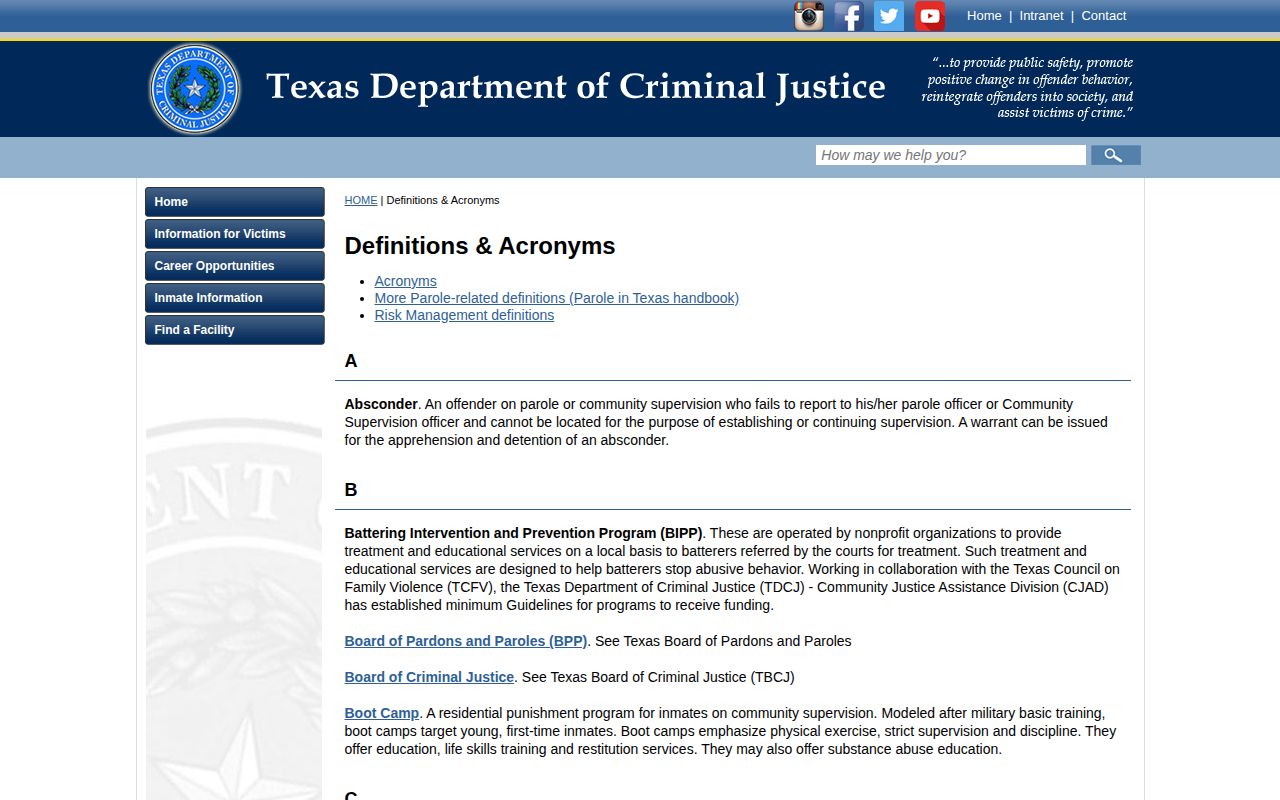
The definition supports reading the field as a current estimate rather than a guaranteed exit.
Two Harrison County Credit Systems
Texas uses separate calculations for a local jail sentence and a TDCJ prison sentence. For a Harrison County jail term, Code of Criminal Procedure Article 42.032 directs the sheriff to award a commutation for good conduct at one day for each day actually served, subject to its rules on forfeiture and restoration. The safe approach is to obtain the Sheriff's calculation and the judgment's jail credit. Counting from the arrest date can be wrong if custody was interrupted or credit was set by the court.
For TDCJ, Government Code Chapter 498 governs good-conduct time. Good time is a privilege that affects classification and release eligibility. It does not reduce the sentence itself as calendar time does. Accrual class can change, and misconduct can result in forfeiture. Chapter 508 then governs parole and mandatory supervision, including discretionary review and ineligible offenses.
The official county-jail credit statute is shown in the source capture below.
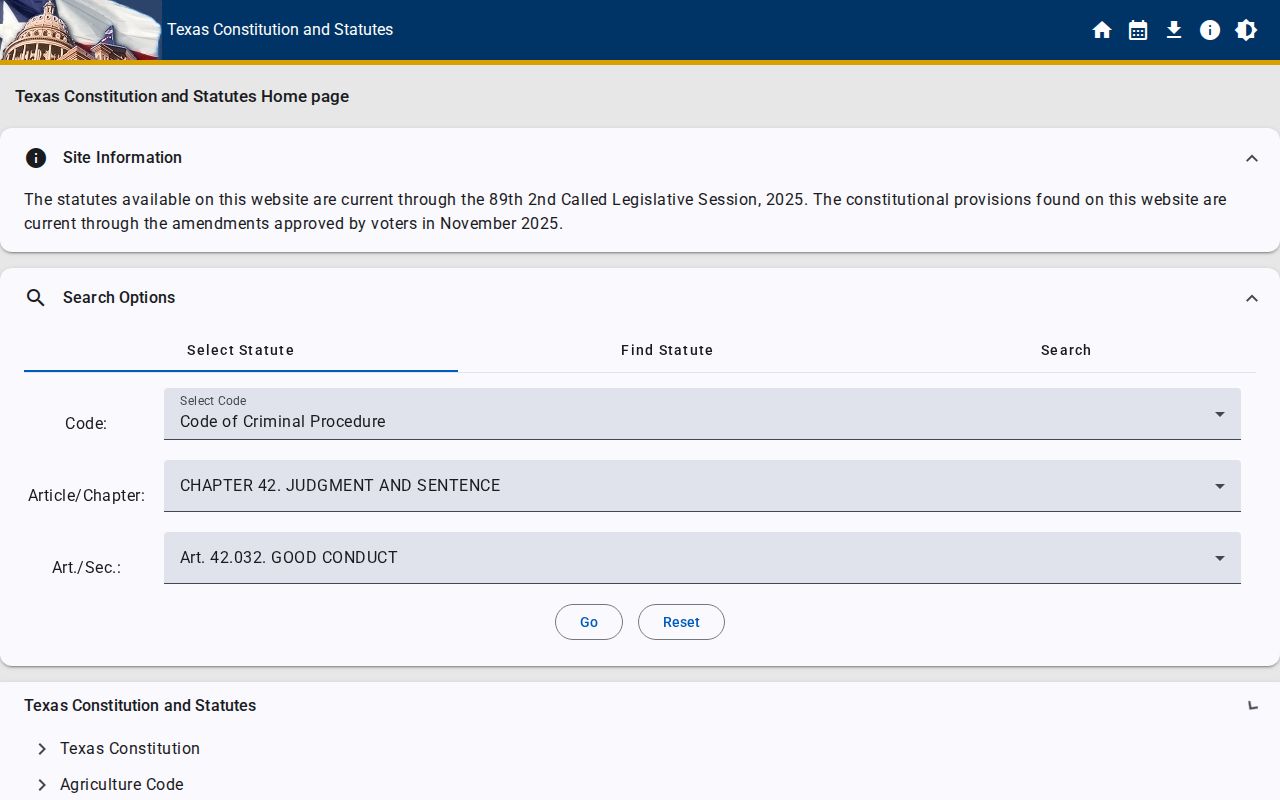
This local credit rule must not be substituted for the TDCJ credit system.
No Universal Texas 85 Percent Rule
Texas has no across-the-board rule requiring every prisoner to serve 85 percent. For specified serious offenses, Government Code Section 508.145(d) generally requires calendar time equal to one-half of the sentence or 30 years, whichever is less, before parole eligibility. Good-conduct time does not shorten that minimum. A life sentence, state-jail felony, or another offense-specific subsection may work differently.
The offense date matters. A 1996 change separates older automatic mandatory supervision rules from later discretionary Board review. Section 508.147 addresses discretionary mandatory supervision, while Section 508.149 lists excluded offenses. A general percentage cannot replace the law and judgment that control one Harrison County case.
The official Chapter 508 release law provides the relevant parole and mandatory-supervision framework.
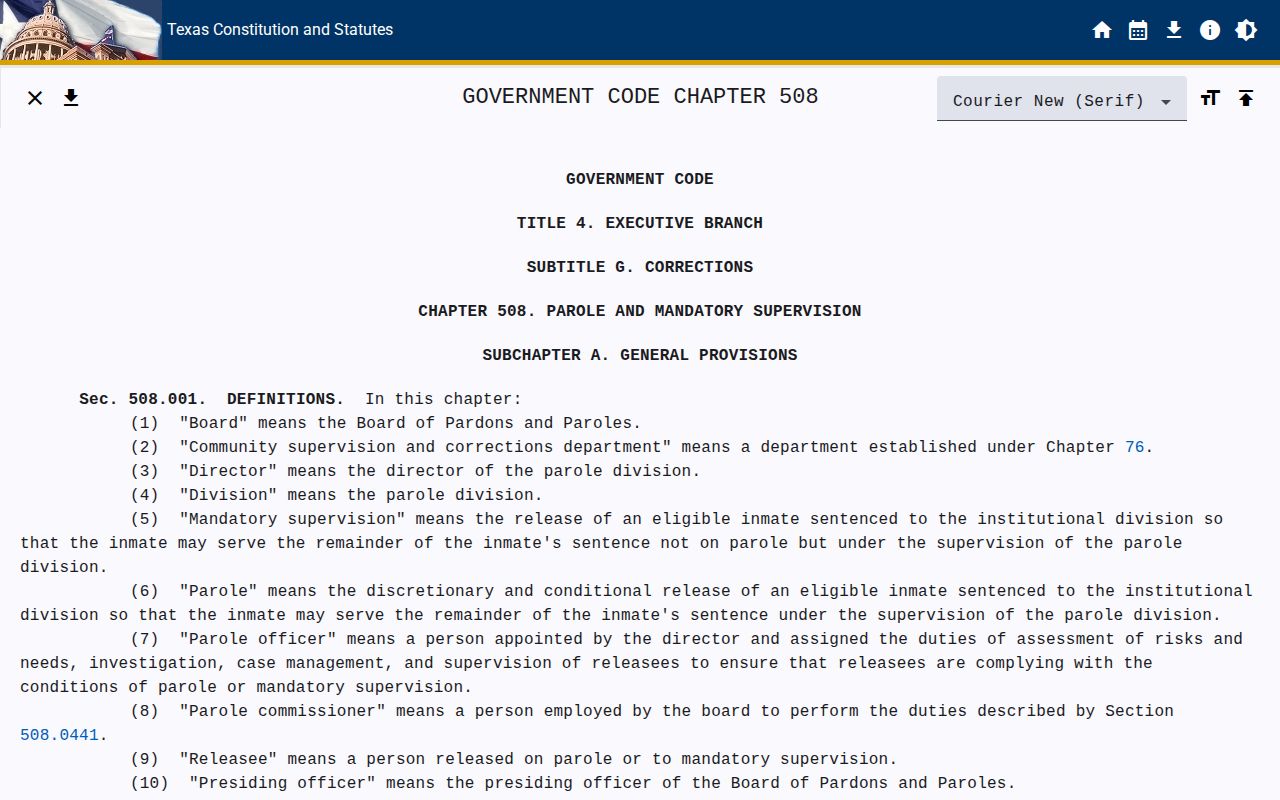
The statute shows why eligibility, approval, scheduled release, and actual release must remain separate.
Why Harrison County Release Dates Move
A projected date can move forward or back as the official record changes. Some factors alter sentence credit. Others do not change the sentence but block the planned release. TDCJ's current field is more reliable than private date arithmetic, yet even the official date can change without notice, including on the scheduled day.
| Factor | Possible effect | Best confirmation |
|---|---|---|
| Good-time class or credit | Changes the current calculation or eligibility | Sheriff or TDCJ Classification and Records |
| Disciplinary forfeiture | Removes some earned credit | Official disciplinary and time record |
| Jail credit or sentence audit | Corrects time already credited | Judgment and calculation record |
| Additional or consecutive case | Extends or changes the controlling term | Court judgment and TDCJ record |
| Parole decision | Approves, conditions, delays, or denies release | Board result and TDCJ review field |
| Detainer or hold | Redirects release to another custodian | Holding and receiving agencies |
| Residence or program condition | Delays scheduling until approved or complete | TDCJ release processing |
Maximum Sentence Date is not the same as parole eligibility. Likewise, an approved parole vote may require a program or later month before release. Record each label exactly.
Confirm Harrison County Actual Release
Before release, Texas IVSS can provide a status-change notice for participating county events, while the separate TDCJ IVSS system covers prison, parole, release, discharge, and warrant events. An alert is useful, but it is not the underlying legal record. Confirm the final event through the Harrison County Sheriff for county custody or TDCJ for state custody.
If a projected TDCJ date differs from the judgment, ask Classification and Records to review the discrepancy. Supply the TDCJ number, cause number, sentence, offense date, and the exact field in question. For Harrison County jail time, ask for the maintained calculation rather than asking staff to predict from an arrest date. A detainer can mean the person leaves one institution and enters another without reaching the community.
- Projected release date
- The present official estimate based on the known record.
- Scheduled release date
- A later processing date assigned as release steps advance.
- Maximum sentence date
- The sentence endpoint shown in the record, subject to lawful calculation.
- Parole eligibility
- The point at which review may occur, not a grant.
- Detainer
- A request or hold that can send the person to another custodian.
Note: Always record the date and time of a lookup because Harrison County and TDCJ status fields can change after a new order or audit.
Harrison County Date Record Requests
TDCJ's email information channel can supply a TDCJ number, location, offense of conviction, incarceration history, the current-incarceration offense and county, and a projected date when applicable. Telephone information is another route when the web record is unclear. A fully discharged person may not retain the same online profile. In that case, request incarceration history, a release certificate, or discharge information through TDCJ's records channels. Supply enough identity data to prevent a same-name error and describe the exact date field in dispute.
County and state dates must also be read with the court file. A Harrison County judgment can show the sentence and credited jail time, while an amended order or appellate mandate may change the calculation. A probation order is not a TDCJ release projection. Parole eligibility and Board review dates also precede any approved and processed release. Compare the date of each record because a later calculation may lawfully replace an earlier one.
For a parole-in-absentia case released from county jail, ordinary TDCJ scheduling may not produce the same fields seen for a prisoner leaving a state unit. Classification and Records generally calculates a scheduled date only after release-certificate processing advances. Residence approval, detainers, required programs, special conditions, and record audits can delay that date. Ask which step remains pending instead of assuming that the first estimate controls.
Harrison County Sentence Date Evidence
A reliable calculation begins with the judgment rather than the arrest date. The court record can identify the offense date, sentence date, sentence length, concurrent or consecutive terms, and credited jail time. Later docket entries may include an amended judgment, appellate mandate, or order that changes credit. For a county-jail sentence, obtain the Sheriff's maintained calculation under Article 42.032. For a TDCJ sentence, compare the judgment with the current state detail and ask Classification and Records to reconcile a material difference.
The offense date matters because Texas release law has changed over time. Mandatory-supervision treatment differs for offenses before and after the 1996 statutory change. Section 508.149 also lists offenses that are ineligible, while Section 508.145 contains several offense-specific parole formulas. A serious-offense calendar-time minimum does not apply to every sentence. State-jail felonies and life sentences need their own governing subsection. That is why a general online percentage cannot establish a Harrison County projected release date.
A county jail departure also may not be release to the community. Another county's warrant, a federal writ, an immigration hold, or transfer to TDCJ can end Harrison County custody while confinement continues. Ask for the destination or receiving agency on the release transaction. If TDCJ has not yet indexed a transfer, allow intake time and search again with the SID or TDCJ number. For a federal or immigration transfer, switch to the responsible federal locator instead of interpreting an absent county result as freedom.
After release, the actual transaction replaces the estimate. Record the date, time, authority, and destination as maintained. The court docket can explain the legal basis, but a bond posting, dismissal, or signed order alone does not prove the moment of physical exit. These records answer different parts of the timeline and should remain labeled as such.
Search Public Records
Sponsored Results